Source: Involvement Culture® QuickScan
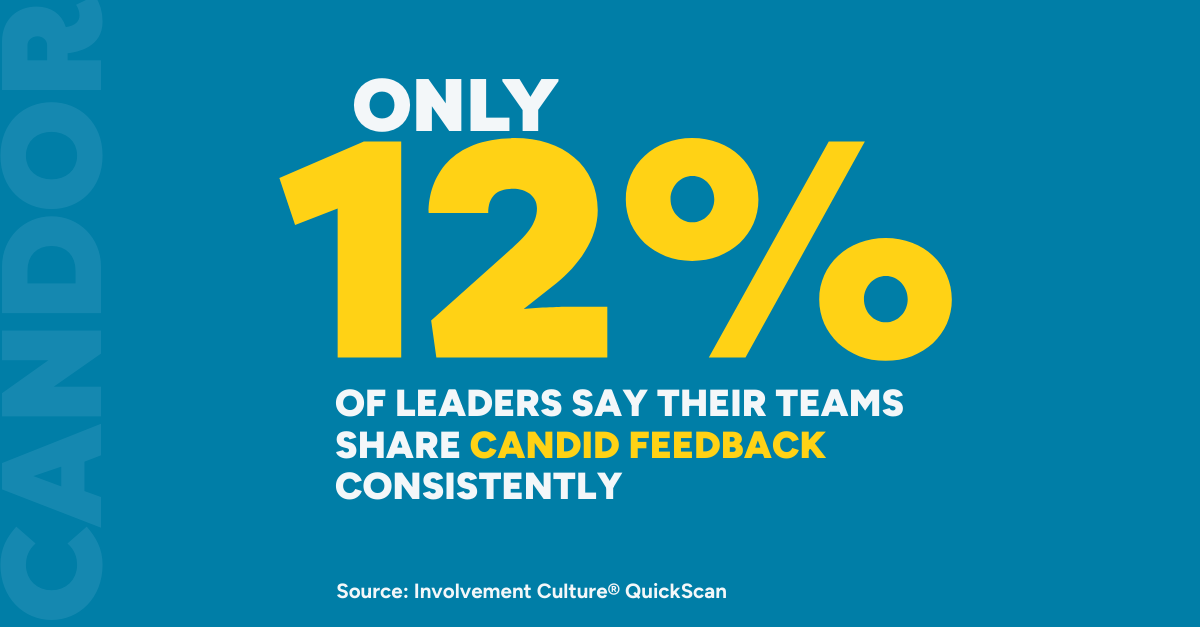
Here's a number that should give every leader pause: only 12% of team leaders say candid feedback happens consistently.
We asked leaders who completed the Involvement Culture® QuickScan a straightforward question as part of the section that signals trust in a culture: "Do team members share concerns, difficult feedback, or dissenting views?" The responses told a clear story:
Rarely: 12%
Occasionally: 38%
Often: 38%
Consistently: 12%
That 76% in the middle – "Occasionally" or "Often" – might feel reassuring at first. It isn't. Occasional candor isn't a culture of candor. It means people are still doing the math before they speak.
Why candor – and why now?
Candor is the lowest-scoring element across all QuickScan respondents this month. Not communication. Not collaboration. Candor – the willingness to say the thing that's hard to say.
It sits within the Trust Culture Indicator, and that connection matters. You can't build genuine trust in a team where people are editing themselves before they speak. The two are inseparable.
What the data is really telling us
The "Occasionally" group is the most revealing. These aren't teams in crisis – they're teams where people sometimes hold back. That gap between "Often" and "Consistently" is where culture work actually lives. It's the difference between a team that can handle a hard conversation when it's unavoidable, and one where honesty is simply how things work.
The 12% in "Rarely" are further along that same path. Unspoken concerns don't disappear – they accumulate. What starts as hesitation becomes disengagement, then conflict, then quiet exits. Leaders are often the last to know.
What consistency actually requires
Moving teams into the "Consistently" category isn't a policy change – it's a leadership behavior change. Three things that actually move the needle:
1. Say it out loud. Tell your team explicitly that dissenting views are welcome. Most people need to hear it said directly before they believe it. Vague open-door policies don't cut it.
2. Model it. Share something you got wrong recently. Modeled vulnerability gives others permission to be honest. If the leader is never wrong, the team quickly learns that being wrong isn't safe.
3. Close the loop. When someone raises a hard thing, show what you did with it. Feedback that is shown to matter gets repeated. Feedback that disappears gets withheld next time.
One question worth sitting with
Are you hearing everyone's voice – or is the most valuable feedback still going unsaid?